
I convinced myself it was hemorrhoids. Then diabetes. Then parasites. Then fungal. Then menopause. But The itch stayed through all of it - until I found out what it really was.
For three years I dealt with an itch I couldn't explain, couldn't fix, and couldn't tell anyone about. Not a mild irritation. A crawling, burning, relentless itch that followed me everywhere.
An itch I spent years learning to hide — lying awake at 3am trying not to scratch because scratching made everything worse and I did it anyway.
Three years later I had five different diagnoses, a drawer full of creams that made it worse, and a genuine moment of sitting on the bathroom floor thinking that maybe this was just how things were going to be now.
This is the story of every wrong turn I took — and the one thing that finally worked.

First I thought it was the hemorrhoid.
It seemed obvious. I'd had one. My GP confirmed it. Hemorrhoids cause itching. I treated it exactly as advised and waited for the itch to follow.
The hemorrhoid resolved. The itch stayed. I went back. My GP examined me, said everything looked normal, and told me this kind of thing is common as we age. She gave me a mild steroid cream and told me to come back if it didn't settle.
It didn't settle. I came back. She said she wasn't sure what else to suggest.
I was forty-seven years old and my doctor was out of ideas after two appointments.

Then I thought it was my diabetes.
I was diagnosed with Type 2 five years ago. I manage it carefully — I know my numbers, I watch what I eat, I take this seriously. But a second doctor, when I described the itch, immediately connected it to my blood glucose. He said high blood sugar affects the skin. He said a better diet, fewer carbohydrates, and yes — another steroid cream — should address it.
I already had a good diet. I already had decent numbers. But I tried what he suggested anyway, because what else was I going to do.
Three months later, nothing had changed. The itch was the same. I'd eaten less pasta and gained nothing.

Then the internet told me it was parasites.
I'm not proud of this chapter. Three weeks of searching symptoms online at midnight will take you to some strange places. And there it was — a description that seemed to match. Nighttime itching specifically. The crawling sensation. All of it.
I treated myself. Followed the full protocol — the medication, the washing, the household routine, all of it, exactly as specified. I waited.
The itch continued. I went deeper into the forums. I found parasite cleanses — herbal, aggressive, "what the pharmaceutical world doesn't want you to know." I tried one.
I won't go into detail, but I felt genuinely unwell for two weeks in a way I hadn't before. I stopped. I threw the rest away.
The medical system, when I raised parasites with my GP, was politely dismissive. She said the tests showed nothing. She said I should try to avoid going too deep into internet health communities. She gave me another referral.

Then I was convinced it was fungal.
I found photographs on a forum. Skin that looked like mine looked, described the way mine felt. The thread said it was a fungal infection — jock itch, candida, something along those lines. Antifungal creams were recommended by multiple people who said they'd had the same thing.
I bought three different antifungal creams across three months. One made things significantly worse within a week. I stopped that one quickly. The other two did nothing at all.
My skin by this point was angrier, more sensitive, more reactive than it had been at the start. Every product I used seemed to leave things worse than it found them.

Then every doctor said it was menopause.
This is the one that broke something in me, I think. Because it stopped being a diagnosis and started being a door closing.
A fourth doctor, then a fifth, then eventually a sixth — each of them, when I described ongoing perimenopausal symptoms alongside the itch, landed on the same conclusion. Dryness. Hormonal changes. Normal for a woman of my age. Here's another steroid cream — a different one this time, slightly stronger.
I looked it up. I tried what they suggested. I woke up at night, uncomfortable, scratching, for another four months while I waited to see if the hormone-related solutions would help. They didn't.
I ran out of doctors willing to look further. I ran out of creams to try. And I ran out of explanations.

The fifth visit to a different hospital changed everything.
I had to push for this referral. Nobody suggested it. I asked, specifically, to see a dermatologist rather than a GP or general practitioner, because I felt strongly by this point that this was a skin problem nobody with skin expertise had actually looked at.
He was older. Unhurried. He asked me to describe exactly what I'd tried, in order, over the three years. He listened without interrupting. Then he examined me.
He said: "This isn't any of those things."
He said that because of the scratching — months and years of it — and because of every product I'd applied trying to fix it, the skin in that area had developed into a condition entirely on its own. Separate from whatever might have originally contributed. Separate from the hemorrhoid, from diabetes, from parasites, from menopause.
He said: "This is anal eczema. And the only thing that addresses it is barrier repair."
He said it so plainly. Like it was obvious. Like it was something I should have been told years ago.

I wasn't going to buy anything else without doing my own research first.
I had earned that much caution. Three years of being sold solutions that made things worse had left me with a very low threshold for promises.
I went to Reddit. Not to self-diagnose — I was done with that — but to find people who'd had the same diagnosis and see what had actually helped them.
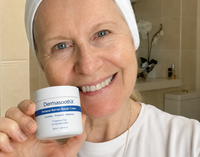
I found a thread from a nurse. She wrote about being embarrassed by having the same condition she'd seen in patients, about the years of failed treatments, about finally understanding that the scratching itself had created a skin-barrier problem that was now self-sustaining. She'd tried something called DermaSoothX. She wrote about it the way I would write about something I genuinely didn't expect to work — with surprise rather than enthusiasm.
I read her post three times. I went back to my dermatologist. I told him what I'd found. I asked about barrier repair specifically, by name. He looked slightly surprised that I'd done this research, but he said: as long as it's natural, there's no harm in trying it. Barrier support is exactly what the skin needs at this stage.
I looked up every ingredient in DermaSoothX before I ordered it. Panthenol — used in dermatology specifically for barrier repair. Zinc Oxide — protective, documented decades of evidence. Colloidal Oatmeal — the FDA classifies it as a genuine skin protectant. Aloe Vera — clinically documented wound-healing. No steroids. No use-limit. Nothing that would thin the skin that had already been thinned by everything I'd already used.
I ordered it without expectations. That felt important. No expectations.

Two weeks in, things were a little calmer.
I noticed it rather than felt it — a slight reduction in how often I was thinking about it. I kept going.
Four weeks in, I slept through the night twice in one week. I hadn't done that in over a year.
Eight weeks in, I got through a full weekend with my family — a long one, a christening, two days of sitting at tables and in cars — and I didn't once have to excuse myself. I didn't once spend half a conversation thinking about whether anyone could tell.
At ninety days, I genuinely had to think hard to remember the last time it had bothered me.
I still use DermaSoothX. Not because the itch is there, but because the barrier that broke down over three years needs consistent support to stay repaired. It's not a cure I use until the problem stops and then put away. It's maintenance, the same way I maintain everything else about my health.

If you've been sent away by doctors and tried everything and made it worse instead of better, maybe the answer really is this simple.
Not simple in the sense of easy. I had to get through three years and every wrong answer to find the right one.
But simple in this sense: the itch that wouldn't go away wasn't a hemorrhoid, or blood sugar, or parasites, or fungus, or menopause. It was the skin barrier breaking down under all the scratching and treatments and time — becoming its own problem, separate from everything that contributed to it.
Anal eczema. A thing I'd never heard of. A thing most of the doctors I saw didn't mention. A thing my own body was dealing with while I chased every other explanation.
DermaSoothX is the only thing I found that actually addresses the barrier directly. Natural ingredients, no use limit, no steroid, no clock running on how long I'm allowed to use it. They offer a 30-day guarantee — if it doesn't work, they'll refund you, no questions.
If you're where I was, I'm not promising anything. I'm just telling you what happened to me.
— Linda
P.S. I never ended up needing another doctor's appointment. I needed the right explanation. Everything after that followed.

Anal Itching Relief
Soothes itching, restores balance and repairs the barrier. Dermatologist‑developed and clinically approved.
CLAIM UP TO 70% DISCOUNT